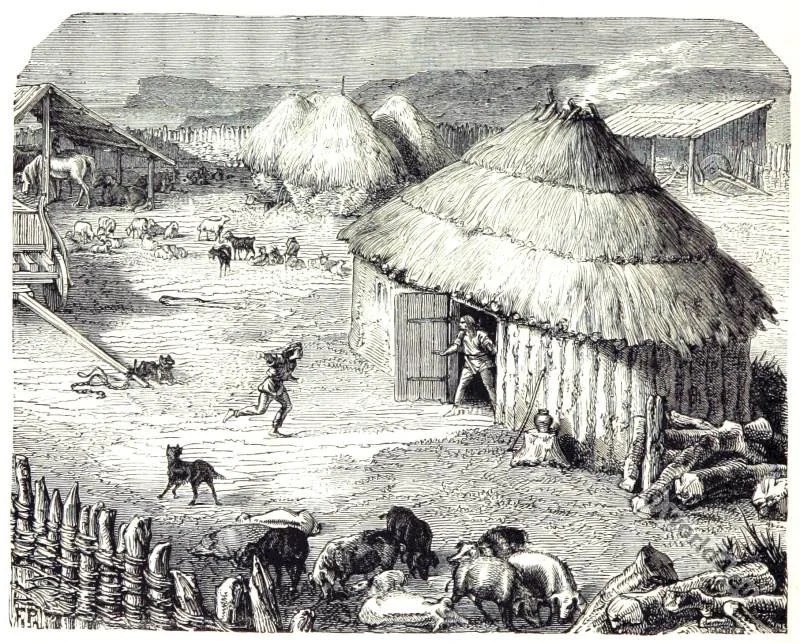
My current work in progress, which I’ve codenamed Project Misty Folk, is an atmospheric elvish fantasy inspired tangentially by Celtic history and lore. Though I am not writing historical fiction, I do want you, my reader, to feel like you have been transported to another place-time altogether. I want you to feel the grime of living in a earth-built haím with hard-packed dirt floors; to smell the stink of life when baths are infrequent and fireplaces are your primary source of heat; to huddle up against your younger sister in the bed you share for warmth during the long winter night. I want you to panic when a crop fails in late summer, and there’s no time to re-plant before the coming winter, so you curse the gods who use human lives as pawns in their unknowable games. I want you to stand in the forest, in awe at the specks that float, catch, glimmer, shift, sway in the gold of the late afternoon sun. Is that a faeling? you might ask. It looks alive. You stand in the river, feet growing cold as the current pulls at your ankles. What is the river spirit trying to tell me? You take in the world around you—the sprouts pushing their way up and out of the dirt with a strength they could not possibly possess at their minuscule size—and ask: what magic ties the disparate fabrics of this universe together?
I think the best way* to accomplish this goal is to research the era closest to the world I’m attempting to build. And what time was more alive with magic and wonder than a time before science unraveled (and perhaps further clouded) the many secrets of our universe?
For this story, I’ve elected to take inspiration from the natural world of my distant heritage. I am mixed European—Scottish and Irish on my father’s side and Ashkenazi Jewish on my mother’s side. I imagine that my very distant ancient ancestors, some two thousand years ago, may have roamed the disparate parts of Europe at the same time,** when Europe was home to the scattered socio-ethnic groups of the Celts.
The “Celts” is a broad term for a variety of European peoples who spoke a similar language and may have shared some belief systems. They existed in both the Bronze and Iron Ages of Europe. The Bronze Age began in Europe in 3,300 BCE and lasted until ~1,100 or 900 BCE, depending on who you’re talking to or about; the Iron began in sometime between ~1,100 BCE and ~900 BCE, and lasted until ~800 CE***.
There isn’t much known for sure of the beliefs, perspectives, or life-ways of pre-Roman Celtic people. They did not appear to have written language of their own (though they did have some symbology that could represent concepts, people, or seasons). Therefore, we only have what made its way down through oral storytelling (or via Christian appropriation of Celtic beliefs); what was written by those who conquered them; and what is found from archeological digs like tools, structures, pottery, and figurines.
Written records of the Celts were documented by Romans conquerors in the early-mid Iron Age, and more extensively by Christian priests when they came to convert the so-called pagans of Europe in the late Iron Age. The first recorded mention of the Celts was recorded in ~400 BCE by Roman conquerors, almost 3,000 years after the “Celts” began settling into more organized social structures.
Dear reader, please realize what this means: the United States of America is turning only 250 years old this year (as I’m writing this in 2026). How many times did we invent and reinvent ourselves over these last two hundred and fifty years? The Bronze Age lasted over two thousand years. Human life spans were much shorter back then. Surely, their societies changed and mottled and shifted like ours does by the decade (if not quite as rapidly). How different would a single village be between 300 BCE and 200 CE? That’s five hundred years apart. If we transported someone living in 600 BCE to 300 BCE, would that society be unrecognizable to her?
Not to mention that the Celts spanned much of the European continent. Their environments were different; their societies must have been molded to the natural world around them, their art constrained by the materials regionally available to them (wool, clay, stone, wood), their diets restricted by what could be grown or hunted. There are disambiguations of the Celtic groups by region, then, of course: Britons, Boii, Calaeci, Celtiberians, Gaels, Galatians, Gauls, and Picts. Probably more. I haven’t researched them all. Sometimes their titles indicate their presence within a specific era, too—the Celtiberians (Spanish Celts) generally lasted from 600 BCE to 70 BCE, before they were dominated by the Romans. You could also divide it by culture-era, such as La Tène or Hallstatt or Jarstorf or Urnfield or Brythionic or…
Well. It is certainly an impossible task to know any of them as we might know ourselves. And do we even know ourselves? I think that humans today are even bad at understanding our own culture, in our own time.
Instead of setting forth an ungovernable task for myself—to take inspiration from a specific people, in a specific place-time, which is very distant and perhaps impossible to truly know—I have instead decided to keep my sources of inspiration broad and vague. This is, after all, a fantasy world I’m creating, home to elves and faeling and piru and brysen and eotenhare and Great Tusked Ganagas.
But I don’t want to create a mish-mash of cultures and end up with something that fits wrong, where beliefs are discordant with the world around my characters, and settlement practices are inappropriate for the tools and resources of their time. I want to be careful. I will be careful.
Over the next couple of posts, I’ll delve into particular aspects of Celtic history, society, art, and lore—and sometimes discuss how its impacts on our world today—to inform my worldbuilding. I hope you’ll enjoy this journey with me!
*Several of the reads I recently devoured late draw from the beliefs, social structures, and mythologies of real historic people, places, and myths: Hild (Nicola Griffith) (the only historical fiction/non-fantasy on this list), The Weaver and the Witch Queen (Genevieve Gornichec), Spinning Silver (Naomi Novik), The Wolf and the Woodsman (Ava Ried), and The Bear and the Nightingale (Katherine Arden).
**Ashkenazi Jews, originally from the Middle East, are theorized to have migrated to Southern and Eastern Europe in the 4th Century BCE, during Europe’s rising Iron Age.
***CE = Common Era, alternative to the religious AD (Anno Domini, Year of our Lord). BCE = Before Common Era.
 Calenn Lithgow
Leave a comment